Writing this post has been on my to-do list for quite some time…and as I am getting more and more messages pertaining to it, I figured it’s time.
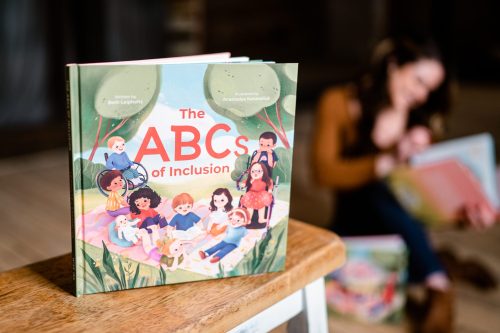
This post is a breakdown of my own experience writing and independently publishing The ABCs of Inclusion, including the financial component in full transparency. Every author’s experience will differ, but hopefully, this can provide some push-off points if becoming a children’s book author interests you.
Step 1: The Idea
I mean duh. This is where it usually starts, right? Maybe it’s been percolating for years, or maybe it came to you suddenly. For me, it was the latter. After writing Hello, Holland, readers planted a seed about my writing a kid’s book. I shrugged it off, thinking it was outside my expertise. But as I was driving home one day, the idea for The ABCs of Inclusion hit me all at once.
I knew a friend from high school had recently published a children’s book, so I started there: by asking what the process had been like, the costs associated, and how she had gone about publishing. In speaking with her, I realized that it was very possible I could do this and make a real, tangible book.
Step 2: The Publishing Decision
This is where my journey already starts a little differently than some. While I had the idea for my book — A children’s ABCs book about disabilities based on real children — I had not yet found the children or written the book.
In most cases, this would be where researching publishers would start. Luckily, my friend had spoken highly of Wise Ink Creative Publishing, the independent publisher she worked with. So I started there.
Before I continue, it’s important to understand the three main types of publishing: self-publishing, traditional publishing, and independent publishing.
- In a self-published book, the author essentially acts as the publisher. Self-publishing is a route that ensures your book makes it out into the world. There is no need for an agent, and the timeline is often much faster than a traditional route. The author also retains rights and control. However, the majority of financial responsibility falls on you.
- Traditional publishing is what people most often associate with books. This is when a publishing house agrees to take on a book and author. The publisher handles costs associated with production and the author receives royalties. The downside to traditional publishing is that the author turns over majority control to the publishing house and the process can be a long one.
- And then there is independent publishing — a hybrid of sorts. In this model, the author works with a company to write, illustrate, edit, and publish the book but is responsible for the costs associated.
The route I took is independent publishing. Because I had not yet written the book, I had nothing to query for an agent or traditional publisher. I needed someone who saw the potential in the idea and would work with me through it. I got in touch with Wise Ink, pitched the idea, and was approved. (It’s worth noting that an independent publisher does not have to take on any author. For example, I believe Wise Ink approves about 20% of pitches).
From there, they laid out the costs and process. The timeline was long: at least a year. Maybe not long in the book publishing world, but to an activator like me, it seemed like ages. I knew I could self-publish much faster, but I was also aware of just how much potential this book had and knew that patience would pay off.
Step 3: Writing and Illustrating
For me, this process also included finding children to feature in the book, which was a bit complicated. Once those pieces came together, I started writing. This differed from a fictional children’s book since all my letters were based on real children.
I sent out questionnaires to each child’s family to gain a complete understanding of each diagnosis. The families also sent images of their children which I planned to pass on to the illustrator.
When it came to finding the perfect illustrator, Wise Ink had me compile examples of children’s book illustrations that spoke to me. I knew I wanted realistic illustrations that truly represented each child while also being a little less colorful than typical children’s books.
Once I sent inspiration over, I had a meeting with Wise Ink to go through a list of illustrators. They were all great and any of them would have worked. But the minute I saw Ana’s work, I fell in love and knew she was the right one for this book. We connected, she did some sample sketches, and everything came to life. Her talent is unmatched and I don’t think anyone could have done this book more perfectly.
The illustrating was one of the longer parts of the process. Ana approached the sketches in stages, taking on a handful of letters each time and sending them for approval or changes. She then went back and added color, which really brought everything to life.
While this part was ongoing, I was making copy edits and finalizing the book text. This part of the process was actually much less intensive than I anticipated, but I think that is because of the content of the book. It was more straightforward and factual information based on real children, so there wasn’t as much of a story to weave in from page to page.
The work on the cover began after all the inner pages had been finalized.
Step 4: Funding & Marketing
I will preface this by saying that when I started this book, I already had a pretty large platform and following on social media. Being in front of the camera and creating content is something I am comfortable with and that comes naturally to me. That is not the case for all authors, so this process may look pretty different from person to person.
In starting this project, I knew it would be expensive. I also knew that I would eventually be doing crowdfunding via Kickstarter to help cover production costs. Toward the end of summer, I launched a 30-day Kickstarter campaign with the goal of raising $10,000.
By the time it ended, more than $65,000 had been contributed.
But this didn’t happen organically or without effort. For those 30 days, I worked my butt off creating videos that explained the origin of this book, the passion behind it, the content inside it. I posted on Tiktok, Instagram Reels, Facebook Reels, and YouTube shorts.
The key to creating content that performs well is to tell a story, to speak to the human element of why someone should CARE that you wrote a book. Creating a video of you talking straight to the camera for three minutes isn’t going to do it. People have short attention spans and will drop off. In order to market your book, you have to market yourself as a human.
(Here is an example of a video that did really well and drove a ton of traffic to the Kickstarter)
The success of the Kickstarter blew me away. It seemed like so much money, more than I could possibly need for production costs…right?
Wrong.
Here’s the part you’ve been waiting for. Publishing a book is expensive. Of that $65,000, there is $10,000 remaining and it will likely all be used shipping out the Kickstarter books. The rest has gone to printing and shipping 9,000 books ($38,000 total), as well as marketing materials and publisher fees. That is in addition to the $15,000 I have paid out of pocket for publishing and illustrating services and have not reimbursed myself for. It’s worth noting some of these costs were optional (i.e. an ASL and visual description video version of the book) but I made decisions based on what I felt aligned with my mission.
I also have a background in web design, photography and marketing, so I handled all of that myself. I could have easily spent another $20,000+ paying someone to do the things I chose to take on myself. I want to note this because if you lack experience in these areas, you will likely have to pay for services here as well. (And please, please, please, put effort into your website. It matters. So much.)
But here’s the thing that also makes this book different…I truly didn’t set out to make any money through the process. My goal from day one was simply not to LOSE money. I’m hoping I am still on track for that, but at the end of the day, I’d rather print more books than pay myself back.
We are at the point in the process now where launch is coming soon (March 21, 2023). At this point, at least 7,000 of the 9,000 books have been pre-ordered — possibly more, as Amazon does not give out pre-order numbers easily.
It’s a little like flying blind at this point. I’m just crossing my fingers and hoping for the best, knowing another print run will be necessary.
(P.S. Canva is the real marketing MVP)
Step 5: Distribution
Technically the decision-making part of this process happens a ways back, but for simplicity’s sake, we will leave it here.
To be honest, I still don’t totally understand every aspect of distribution. Book publishing is a whole new world and I am learning as I go. But of the options presented to me, I chose the most hands-off and least profitable.
I did not want to be responsible for taking and shipping orders myself (apart from the Kickstarter ones), as I simply do not have the time to do so. The route I chose allows my book to be sold and shipped via Amazon, but also by local retailers. The approach to each is different and is something where I am still learning the rope.
Step 6: Launch & Events
And…here we are! Present day. The focus now is getting the book out in the world and planning events to make that happen.
Honestly, I have enjoyed every part of this process. It’s been a learning experience, and there’s been a panic attack or two, but I would do it over time and time again.